
MRI Patient Transport equipment exists because the wheelchair or gurney that brought a patient to the department cannot go the last few feet into the magnet room. Standard hospital wheelchairs and stretchers are largely steel, and steel is ferromagnetic. Brought into Zone IV, they are among the most common causes of MRI projectile incidents. MRI Med carries non-ferrous stretchers, wheelchairs, walkers, and patient transfer aids, along with the accessories that keep them useful over years of service.

This category is for MRI technologists, transport and nursing staff, radiology managers, and facilities teams responsible for how patients move between the waiting area, Zone III, and the scanner table. MRI Med is owned and operated by people with more than 80 years of combined MRI experience, and safety is one of the three pillars of its mission, alongside patient comfort and operational efficiency.

Why transport equipment is a leading MRI safety risk

Why transport equipment is a leading MRI safety risk

The static magnetic field is always on. It does not switch off between patients, at night, or when the console is idle, and its pull on a ferromagnetic object increases sharply as that object approaches the bore. A steel wheelchair or stretcher that crosses the Zone IV threshold can accelerate toward the magnet with force that has injured patients and staff and taken scanners out of service for days. Transport equipment is involved in these events more than almost any other object class because it is large, heavy, and routinely rolled by people who may not work in MRI every day.

The solution is to keep ferromagnetic transport out of the room entirely. Non-ferrous equipment built from aluminum, non-magnetic stainless, and plastics allows a patient to be wheeled directly to the table without a hand-off in the hallway. Clear labeling, a dedicated storage location, and staff training close the loop so that the right chair or stretcher is the only one that ever enters Zone IV.

MRI patient transport product categories

MRI Stretchers

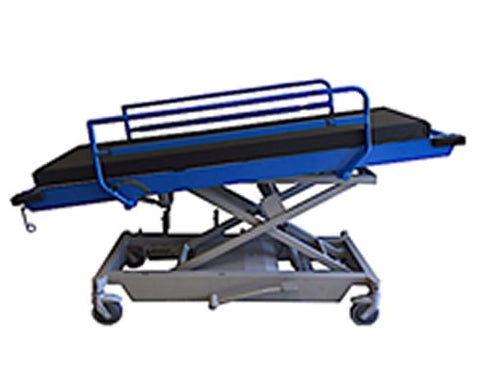
An MRI Stretcher is built from non-ferrous materials and is height-adjustable so that the deck can be brought level with the scanner table for a lateral transfer. Stretchers designed for the MR environment are used to move patients who cannot walk or sit upright, including sedated, post-operative, and emergency patients. Look for MR Conditional labeling and confirm the field-strength conditions before the stretcher is assigned to your suite.

MRI Wheelchairs

A Non-Magnetic Wheelchair lets an ambulatory-but-unsteady patient ride from the changing area to the table without swapping chairs at the door. MRI wheelchairs replace the steel frame, bearings, and hardware of a standard chair with non-ferrous alternatives. Because they look similar to ordinary chairs, they should be visibly marked and stored inside the controlled area rather than mixed into the department's general fleet.

MRI Walkers

Some patients simply need something to hold on to. An MRI Walker gives an elderly or post-surgical patient stable support for the short distance from the door to the table, and it removes the temptation for staff to let a patient bring in their own aluminum-framed walker with steel fittings.

MRI Patient Transfer

MRI Patient Transfer products, such as transfer boards and slide sheets, help staff move a supine patient from a stretcher onto the scanner table and back. They reduce lifting strain on technologists, protect patients with fractures or lines, and shorten the time the room is occupied. Transfer aids built for MRI avoid ferromagnetic handles, rivets, and stiffeners.

MRI Stretcher Accessories and MRI Wheelchair Accessories

Accessories keep transport equipment in service and adapted to your patients. MRI Med carries Stretcher Accessories and Wheelchair Accessories intended for use with equipment in the MR environment. When replacing a part, or adding on to the unit, buy the part designed for the MRI unit; a standard replacement from the general supply room may reintroduce a ferromagnetic component into a chair or stretcher that was previously safe to use in Zone IV.

How to choose MRI Patient Transport equipment

How to choose MRI Patient Transport equipment

Start with the ASTM F2503 labeling. MR Safe items are non-conducting, non-metallic, and non-magnetic, which is rare for a wheeled device that must carry an adult. Most MRI Stretchers and Wheelchairs are MR Conditional, meaning they are safe under specific conditions such as a maximum static field strength and spatial gradient. Read those conditions and confirm they match your scanner, including any plans to upgrade to a higher field system.

Next, match capacity and fit to your patients and your room. Consider the weight rating, the width of the door and the path to the table, and whether the stretcher's height range reaches your table height for lateral transfer. For bariatric patients or a pediatric practice, dimensions matter as much as materials.

Then think about workflow and control. Decide where the MRI Wheelchair and Stretcher will live, how they will be marked, and who is allowed to bring them past the Zone III door. Ferromagnetic Detection and Test Magnets from MRI Med's MRI Safety category help confirm that nothing has been swapped or added, and a written procedure for transport equipment is a reasonable expectation under ACR guidance and Joint Commission review.

Finally, budget for cleaning and upkeep. Transport surfaces contact every patient, so choose materials that tolerate your disinfectants.

Why order MRI Transport Equipment from MRI Med

Why order MRI Transport Equipment from MRI Med

MRI Med designs, manufactures, and distributes products for the MRI market from California, and its team has decades of hands-on experience in MRI product development. That matters for Transport Equipment, where products can look-alike a product from a general medical supplier although it is an MR Unsafe device. The category is organized around how patients actually move through a suite, and it connects naturally to MRI Med's MRI Suite Furniture, MRI Safety, and MRI Patient Comfort ranges for the rest of the room.

If you need help specifying a stretcher, wheelchair, or transfer setup for your scanner, contact the MRI Med team by phone or email.

Frequently Asked Questions

Can you bring a regular wheelchair into an MRI room?

No. Standard wheelchairs contain steel frames, bearings, and hardware that are strongly ferromagnetic and can be pulled into the magnet. Patients should transfer to a Non-Magnetic MRI wheelchair before entering Zone IV, or walk in with an MRI Walker if they are able. Never rely on appearance; only a chair with MR Safe or MR Conditional labeling belongs in the magnet room.

What is an MR Conditional stretcher made of?

Stretchers for the MR environment use non-ferrous materials such as aluminum, non-magnetic stainless steel, and plastics in place of the carbon steel used in standard gurneys. Most are labeled MR Conditional rather than MR Safe, with stated limits on field strength and spatial gradient. Confirm those conditions match your scanner before assigning the stretcher to the suite.

How do you keep a standard wheelchair or gurney out of the MRI room?

Access control does most of the work. Keep Zone IV doors closed and locked when the room is unattended, post clear MRI Safety Signs at the Zone III and IV entries, and stage MR Conditional Transport Equipment inside Zone III so there is never a reason to bring the general hospital transport equipment further. Distinct labeling on Non-Magnetic Stretchers and Wheelchairs, plus Ferromagnetic screening at the door, closes the remaining gaps.

Can a patient use their own walker in the MRI suite?

Usually not. Even walkers with aluminum frames often have steel fasteners, springs, or wheel hardware. Have the patient switch to an MRI Walker at the Zone III boundary and keep their personal walker outside the magnet room. Screening every item, including mobility aids, is part of standard MRI access control.

How do you move a patient from a stretcher onto the MRI table?

Bring a height-adjustable MRI Stretcher level with the table, lock the wheels, and use a Transfer Board or slide sheet to move the patient laterally. This limits lifting, protects patients with lines or injuries, and keeps the process quick. All equipment used in the transfer, including the board, should be appropriate for Zone IV.

Do MRI Stretchers and Wheelchairs need to be labeled?

Yes. The most dangerous transport item is a chair that looks like every other chair, because staff cannot tell which one is safe. Apply MR Safe or MR Conditional labels, store MRI equipment inside the controlled area, and train transport and nursing staff so that only marked equipment ever crosses into Zone IV.

What should be included in an MRI Patient Transport setup?

At minimum, a Non-Magnetic Wheelchair and an MRI Stretcher with a transfer board cover most patients. Add an MRI Walker for ambulatory patients who need support and keep the correct stretcher and wheelchair accessories in stock. Pair the equipment with signage and ferromagnetic screening so the transport process stays safe as staff change.