

Item Number: SKU:SM-306
Hand-Held Ferromagnetic Detector - MR CONDITIONAL
Hand-Held Ferromagnetic Detector - MR CONDITIONAL
 What does this mean?

MR Safe – an item that poses no known hazards in all MRI environments. Using the terminology, “MR Safe” items are non-conducting, non-metallic, and non-magnetic items such as a plastic Petri dish. An item may be determined to be MR Safe by providing a scientifically based rationale rather than test data.

MR Conditional – an item that has been demonstrated to pose no known hazards in a specified MR environment with specified conditions of use. “Field” conditions that define the MR environment include static magnetic field strength, spatial gradient magnetic field, dB/dt (time rate of change of the magnetic field), radio frequency (RF) fields, and specific absorption rate (SAR). Additional conditions, including specific configurations of the item (e.g., the routing of leads used for a neurostimulation system), may be required.

MR Unsafe – An item that is known to pose hazards in all MRI environments. MR Unsafe items include magnetic items such as a pair of ferromagnetic scissors.
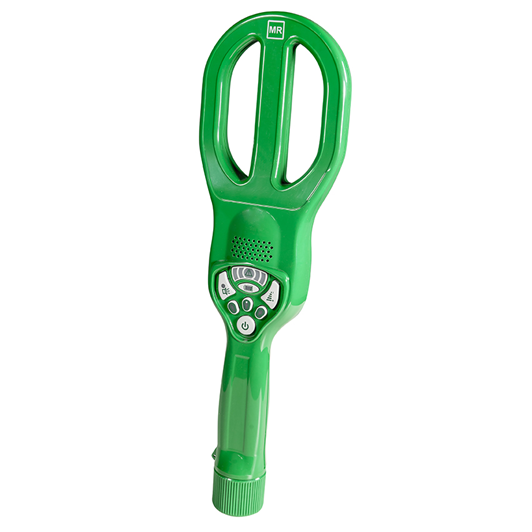
The Hand-Held Ferromagnetic Detector - MR CONDITIONAL is an innovative and essential tool for MRI rooms, designed to enhance patient safety and streamline the screening process. Engineered for precision, this portable patient screener can detect magnetic metal masses, or both magnetic and non-magnetic metals, based on operator-configured settings. It is the only handheld screening device capable of separately identifying ferrous and non-ferrous metallic items, offering protection against the risks of adverse interactions with the magnetic field as well as RF-induced heating. With its non-magnetic construction, this device operates seamlessly within ZONE IV environments and is specifically MR Conditional up to 3T.
Features:
- Handheld ferromagnetic detector
- Large search area for fast and accurate screenings
- Dual-tone and dual-color displays for high precision
- Three level sensitivity selection
- Allows for targeted ferrous detection around the head and body or complete metal detection for the entire body
- Audible and visual-magnitude alerts help pinpoint metallic objects
- Helps reduce risks associated with localized RF burns from metallic items
- MR Conditional to 3T
Overall Dimensions:
- 15.9”L x 4.7”W x 1.6"H
Note: While suitable for use inside Zone IV, it should be noted that screening should always take place in Zones II and III to avoid accidents and projectiles.
Couldn't load pickup availability
Frequently Asked Questions
Additional Resources

Innovations in MR Conditional Transport Devices (2025 Trends)

Avoiding MRI Suite Accidents During Patient Transfers: Best Practices

Case Study: MRI Transport Efficiency in a Mid-Size Hospital

MR Conditional Wheelchairs vs. Stretchers: Which Is Right for You?

How to Design an MRI Suite Transport Workflow: Step-by-Step Guide

MRI Patient Transport Solutions: Safe and Efficient Options

What Hospitals Get Wrong About MR Safe Equipment

MRI Safety Standards for Medical Equipment in 2025

MR Zones I-IV: Equipment Guidelines You Must Know

ASTM F2503: What It Means for MRI Equipment Buyers

Understanding MR Safe, MR Conditional, and MR Unsafe Labels
