
Skip to product information
1 of 1

Item Number: SKU:SM-307

TechGate™ MRI Safety Access Control

TechGate™ MRI Safety Access Control

MR Unsafe What does this mean?
MR Safe

MR Safe – an item that poses no known hazards in all MRI environments. Using the terminology, “MR Safe” items are non-conducting, non-metallic, and non-magnetic items such as a plastic Petri dish. An item may be determined to be MR Safe by providing a scientifically based rationale rather than test data.

MR Conditional

MR Conditional – an item that has been demonstrated to pose no known hazards in a specified MR environment with specified conditions of use. “Field” conditions that define the MR environment include static magnetic field strength, spatial gradient magnetic field, dB/dt (time rate of change of the magnetic field), radio frequency (RF) fields, and specific absorption rate (SAR). Additional conditions, including specific configurations of the item (e.g., the routing of leads used for a neurostimulation system), may be required.

MR Unsafe

MR Unsafe – An item that is known to pose hazards in all MRI environments. MR Unsafe items include magnetic items such as a pair of ferromagnetic scissors.

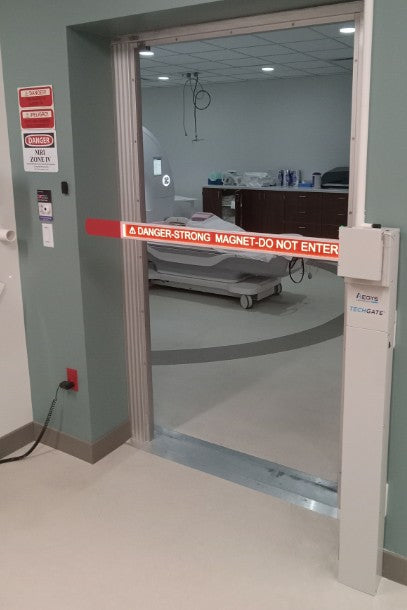
TechGate™ is an automated access-control solution designed specifically for MRI environments, helping facilities better manage entry into Zone 4 while making MRI safety communication more visible and intuitive. By combining a robotic, illuminated barrier with automated sensing, MRI-conditional remote controls, and emergency breakaway functionality, TechGate helps reduce the risk of unauthorized access and human error while supporting a safer, more efficient MRI workflow. Intended for installation between Zone III and Zone IV.

Key Features:

  • Automated Zone 4 access control: Helps restrict physical access to the MRI room and reduce the risk of unauthorized entry
  • Illuminated safety communication: LED lighting provides an immediate visual indication of MRI room conditions and hazards
  • Automated sensor operation: Integrated infrared sensors enable hands-free, responsive barrier operation
  • MRI-conditional remote controls: Provides convenient control designed for use in the MRI environment
  • Emergency breakaway design: Patented breakaway arm supports rapid egress when needed
  • Flexible installation: Designed to accommodate a range of MRI doorways and suite configurations
  • Workflow-focused design: Helps reduce interruptions, improve staff efficiency, and support patient throughput
  • Rapid, easy installation: Installation can typically be completed by user in approximately 15–20 minutes
View full details

Frequently Asked Questions

1. How does MRI TechGate help prevent unauthorized access to the MRI room?

TechGate creates a physical, automated barrier that stops unscreened people before they reach the magnet room door. With remote-control deployment, LED warnings, and safety sensors, it gives technologists a reliable way to secure the entrance even when they’re busy with a patient or working alone. Facilities use it to solve common safety risks like shared corridors, overlapping imaging suites, and visitors wandering near Zone IV.

2. Is MRI TechGate easy to install in existing MRI suites or tight doorways?

Yes. TechGate is designed for real MRI layouts, including narrow hallways and non-standard door swings. The unit uses a small side-wall footprint and plugs into a standard outlet, so most sites install it in minutes without construction work. Before installation, we review simple door photos and site details to make sure the fit and configuration match your facility’s workflow.

3. What features make TechGate reliable for daily MRI operations and high-risk environments?

TechGate uses modular robotic arms for a consistent physical barrier, bright LED signage for visibility, and a breakaway function for emergencies. Technologists appreciate that it reduces interruptions and keeps the access point controlled, even during complex cases or heavy patient flow. It’s built specifically for MRI environments, so it maintains clear access control without interfering with equipment or scanning operations.

Additional Resources

Innovations in MR Conditional Transport Devices (2025 Trends)

Innovations in MR Conditional Transport Devices (2025 Trends)

The landscape of MRI patient transport is evolving rapidly. Hospitals and imaging centers are pri...
Read more
Avoiding MRI Suite Accidents During Patient Transfers: Best Practices

Avoiding MRI Suite Accidents During Patient Transfers: Best Practices

Patient safety is the top priority in MRI suites. Accidents during patient transfers can lead to ...
Read more
Case Study: MRI Transport Efficiency in a Mid-Size Hospital

Case Study: MRI Transport Efficiency in a Mid-Size Hospital

Efficient MRI patient transport is critical for patient safety, scanner throughput, and overall w...
Read more
MR Conditional Wheelchairs vs. Stretchers: Which Is Right for You?

MR Conditional Wheelchairs vs. Stretchers: Which Is Right for You?

When it comes to MRI patient transport, choosing the right device can dramatically affect both pa...
Read more
How to Design an MRI Suite Transport Workflow: Step-by-Step Guide

How to Design an MRI Suite Transport Workflow: Step-by-Step Guide

Transporting patients safely in an MRI environment is a complex task that combines patient safety...
Read more
MRI Patient Transport Solutions: Safe and Efficient Options

MRI Patient Transport Solutions: Safe and Efficient Options

Moving patients safely in an MRI environment is more than just pushing a stretcher or wheelchair ...
Read more
What Hospitals Get Wrong About MR Safe Equipment

What Hospitals Get Wrong About MR Safe Equipment

Hospitals rely on MRI technology every day for life-saving diagnoses. But many facilities still m...
Read more
MRI Safety Standards for Medical Equipment in 2025

MRI Safety Standards for Medical Equipment in 2025

Medical imaging, particularly MRI, relies on strong magnetic fields to produce detailed diagnosti...
Read more
MR Zones I-IV: Equipment Guidelines You Must Know

MR Zones I-IV: Equipment Guidelines You Must Know

MRI safety is crucial for protecting patients, staff, and imaging equipment. MRI scanners generat...
Read more
ASTM F2503: What It Means for MRI Equipment Buyers

ASTM F2503: What It Means for MRI Equipment Buyers

MRI equipment safety is critical for protecting patients, staff, and ensuring high-quality imagin...
Read more
Understanding MR Safe, MR Conditional, and MR Unsafe Labels

Understanding MR Safe, MR Conditional, and MR Unsafe Labels

Medical imaging, particularly MRI, relies on powerful magnetic fields. Using the wrong type of eq...
Read more
How to Choose MR Safe Equipment: Compliance, Safety, and Zones

How to Choose MR Safe Equipment: Compliance, Safety, and Zones

MRI is one of the most advanced diagnostic tools available today. However, its powerful magnetic ...
Read more